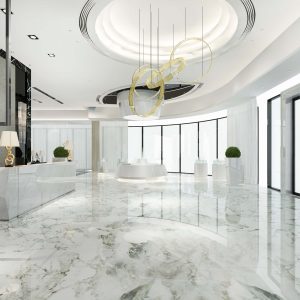
Marble
Marble: A Metamorphic Rock with Many Uses
Marble is a metamorphic rock that forms when limestone or dolomite is subjected to heat, pressure and aqueous solutions. It is composed of interlocking crystals of carbonate minerals, usually calcite or dolomite. Marble has a crystalline texture that varies in thickness and can be polished to a high shine. Marble is widely used for sculpture, architecture and decorative purposes.
Its name comes from ancient times, precisely from ancient Greece: the word derives from the verb “marmar“, which means “to shine“.
Types of Marble
There are many types of marble, depending on the color, pattern, origin and composition of the rock. Some of the most common and popular types are:
• Carrara marble: This is a white or blue-gray marble from Carrara, Italy. It is one of the most famous and oldest types of marble, used by many artists such as Michelangelo and Canova. It has a fine-grained texture and linear veins.
• Calacatta marble: This is a rare and expensive type of white marble from the same region as Carrara. It has a distinctive golden or gray veining on a white background.
• Crema Marfil marble: This is a beige or yellowish marble from Spain. It has a uniform color and a smooth texture.
• Emperador marble: This is a brown marble from Spain. It has a dark color and contrasting white veins.
• Makrana marble: This is a white marble from India. It is one of the purest and most durable types of marble, used for the Taj Mahal and other monuments.
• Travertine marble: This is a porous and textured type of marble that forms near hot springs. It has a beige or reddish color and often contains fossils or holes.
• Onyx marble: This is a translucent type of marble that has bands of different colors. It is often used for backlighting or decorative purposes.
The following table summarizes some of the characteristics and uses of these types of marble:
Carrara – White or blue-gray – Italy – Sculpture, architecture, countertops
Calacatta – White with golden or gray veins – Italy – Sculpture, architecture, countertops
Crema Marfil – Beige or yellowish – Spain – Flooring, wall cladding, countertops
Emperador – Brown with white veins – Spain – Flooring, wall cladding, countertops
Makrana – White India – Sculpture, architecture, monuments
Travertine – Beige or reddish – Various – Flooring, wall cladding, sinks
Onyx – Various with bands – Various – Backlighting, decorative items
Extraction Locations
Marble is extracted from quarries around the world using various methods such as drilling, blasting, cutting and polishing. Some of the most famous and productive marble quarries are:
• Carrara quarry: This is the largest and oldest marble quarry in the world, located in the Apuan Alps in Tuscany, Italy. It has been operating since the Roman times and produces about one million tons of marble per year.
• Penteli quarry: This is the quarry that supplied the marble for the Parthenon and other ancient Greek buildings. It is located in the Penteli mountain range in Attica, Greece. It still produces high-quality white marble with a golden hue.
• Danby quarry: This is the largest underground marble quarry in North America, located in Vermont, USA. It produces about 200,000 tons of marble per year in various colors and grades.
• Yule quarry: This is the quarry that supplied the marble for the Lincoln Memorial and other landmarks in Washington D.C. It is located in Colorado, USA. It produces about 40,000 tons of white marble per year.
Uses of Marble
Marble has many uses in various fields such as art, architecture, design and industry. Some of the most common uses are:
• Sculpture: Marble is one of the most preferred materials for sculpting because of its beauty, durability and workability. It can be carved into realistic or abstract shapes with fine details and smooth surfaces. Some of the most famous marble sculptures are David by Michelangelo, Venus de Milo by Praxiteles and The Thinker by Rodin.
• Architecture: Marble is one of the most popular materials for building because of its elegance, strength and versatility. It can be used for exterior or interior walls, columns, domes, floors, stairs and other elements. Some of the most famous marble buildings are the Pantheon in Rome, the Taj Mahal in India and the White House in USA.
• Design: Marble is one of the most sought-after materials for design because of its aesthetic appeal, variety and functionality. It can be used for countertops, backsplashes, fireplaces, sinks, bathtubs and other features. Marble can also be combined with other materials such as wood, metal or glass to create unique effects.
• Industry: Marble is one of the most useful materials for industry because of its hardness, resistance and chemical properties. It can be used for abrasives, fillers, pigments, paper making and other applications. Marble can also be processed into powder or slabs for different purposes.
Conclusion
Marble is a metamorphic rock that has many types, extraction locations and uses. It is one of the most valuable and versatile natural stone materials that can enhance any space with its beauty and quality.
Showing the single result